
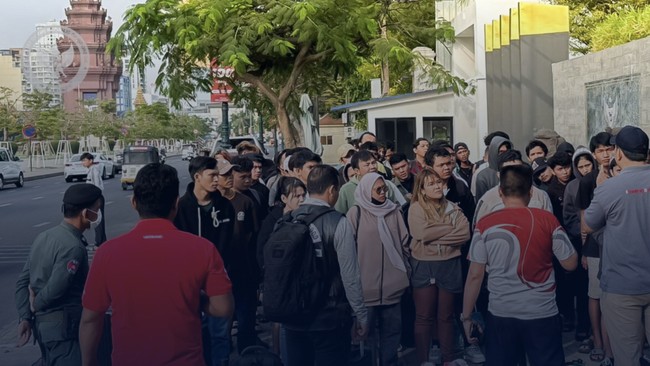
Since mid-January 2026, more than 12,000 Indonesians have walked into the Indonesian Embassy in Phnom Penh asking to be sent home after leaving online-scam operations in Cambodia. Many arrived without passports, which their employers had kept, and with visas that had long expired. It is the largest wave the embassy has ever handled: in all of 2025 it recorded 5,088 cases.
How people end up in the compounds
The pattern is well documented. Recruiters advertise jobs as e-commerce operators, customer-service staff or restaurant workers in Facebook and Telegram job groups, buy the plane tickets and send workers on tourist visas via Singapore, Malaysia or Thailand. On arrival, according to the national police, workers are taken to scam companies where they work 14 to 18 hours a day against targets, are not allowed to leave guarded buildings and are sometimes not paid at all (Republika).
Indonesia has no labour-placement agreement with Cambodia. Since March 2025 the government has formally banned its citizens from working in Cambodia, Myanmar and Thailand because of the trafficking risk, and it treats every Indonesian working there as undocumented (Antara). The ban has not stopped the flow.
What happened in 2026
On 16 January, Cambodia intensified a nationwide crackdown ordered by Prime Minister Hun Manet. Syndicates dissolved and simply let their workers go. By 19 January, 911 Indonesians had come to the embassy; within ten days the number passed 2,400 (CNBC Indonesia, CNA). Arrivals continued for months: 6,308 by late March, 8,002 by early May, when up to 180 people came in a single day and the embassy shelter was full, and 12,583 by August (Antara, CNBC Indonesia, Investortrust).
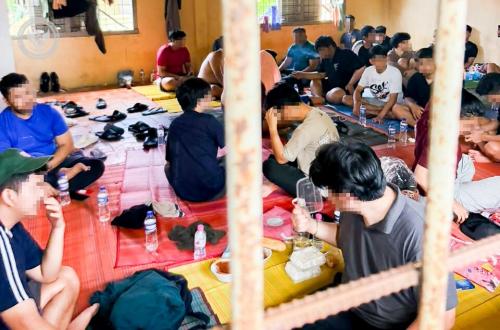
Cambodia also changed its law. An Anti-Cyber Scam Law passed on 7 April 2026 carries fines of up to US$500,000 and life imprisonment (Metro TV). Raids now reach areas that were rarely touched before, such as the border town of Poipet. On 4 October, police there detained 550 Indonesians in one operation, the largest single arrest of Indonesians on record (IDX Channel).
Not everyone made it home. In March, a 22-year-old woman from Siak, Riau, who had been promised a job in Malaysia but was taken to Cambodia, died in a Phnom Penh hospital; her family had to pay to bring her body home (Antara).
How the government has responded
- Repatriation. The embassy issues emergency travel documents to those without passports, negotiates waivers of overstay fines (US$10 a day) and runs a temporary shelter. By August, 8,124 people had returned. Many pay for their own tickets.
- Diplomacy. The ambassador met Cambodia's anti-scam commission in January to speed up deportations. In late July, Deputy Foreign Minister Arif Havas Oegroseno visited Phnom Penh, and in August the government announced an "Indonesia Desk" at Cambodian police headquarters, involving the police, the Attorney General's Office, the financial regulator OJK and the financial intelligence unit PPATK (The Star, Investortrust).
- Screening. The embassy assesses returnees for signs of trafficking and says they are examined again on arrival in Jakarta. Police brought back 249 people from Cambodia and Myanmar in January as suspected trafficking victims (Republika).
Victims or perpetrators?
The wave has split officials. In February the embassy said none of 3,595 Indonesians it had assessed showed signs of being trafficking victims (InfoPublik). OJK chairman Mahendra Siregar said those returning were part of scams targeting Indonesians and should not be welcomed "as heroes" (detikFinance). Lawmakers warned against lumping everyone together: a member of House Commission XIII said a careless approach "risks violating human rights", while insisting that recruiters and coordinators must not escape (CNA). Migrant CARE argues the 2007 anti-trafficking law is outdated because it does not cover digital crime (Suara Surabaya).
What is still unresolved
As of October 2026, hundreds of Indonesians remain in Cambodian detention and new arrests continue. From 1 July, Cambodia stopped waiving overstay fines for Indonesians, which the foreign ministry calls homework still to negotiate (Investortrust). The embassy says some Indonesians are still arriving in Cambodia to join scam operations. It remains unclear how many recruiters at home have been charged, how returnees who were coerced are being supported, and whether the placement ban can work when jobs are sold on social media every day.
Update history
Largest-ever arrest of Indonesians: 550 in Poipet
Cambodian police detained 550 Indonesians in a single raid on an online scam and gambling operation in Poipet, the largest arrest of Indonesians in one operation on record. The embassy is pushing for their transfer to Phnom Penh and deportation.
An "Indonesia Desk" inside Cambodian police
The government announced an Indonesia Desk at Cambodian police headquarters, involving the police, the Attorney General’s Office, OJK and PPATK. By then 12,583 had asked to go home and 8,124 had returned; 991 were in shelters. Cambodia had stopped waiving overstay fines for Indonesians from 1 July.
Deputy foreign minister visits Phnom Penh
Deputy Foreign Minister Arif Havas Oegroseno met Cambodia’s anti-scam commission. Both countries pledged closer cooperation, and Indonesia offered to train Cambodian law-enforcement officers.
Double last year’s total, 1,840 in detention
The foreign ministry said cases in the first half of 2026 had already doubled the 2025 total; 12,019 had reported by the end of June. About 1,840 Indonesians were in Cambodian immigration detention.
Second surge fills the embassy shelter
After the Khmer New Year, raids reached border areas such as Poipet. Reports climbed to 8,002, with 180 people arriving on 5 May alone; the embassy shelter reached capacity and new arrivals were put on a waiting list.
Issue started
The problem began. The counter runs from this day.
Sources & resources
Reporting, records and posts this page is built on. Links open on the original site.
 (News) (opens in a new tab)
CNBC Indonesia· News
Sindikat Bubar, 911 WNI di Kamboja Serbu KBRI
Hari-hari pertama razia Kamboja: 911 WNI mendatangi KBRI Phnom Penh dalam tiga hari.
cnbcindonesia.com
- (News) (opens in a new tab)
detikFinance· News
Bos OJK Sebut WNI di Kamboja Bukan Korban, tapi Pelaku Scam
Ketua OJK menyebut WNI eks sindikat sebagai pelaku, bukan korban.
finance.detik.com
- (News) (opens in a new tab)
CNA Indonesia· News
Ribuan WNI minta dipulangkan dari Kamboja, korban atau pelaku kejahatan scam?
Perdebatan soal memilah korban TPPO dan pelaku scam.
cna.id
- (News) (opens in a new tab)
Republika· News
249 WNIB Korban TPPO Dipulangkan dari Kamboja
Polri memulangkan 249 WNI dari Myanmar dan Kamboja; modus rekrutmen lewat Facebook dan Telegram.
news.republika.co.id
- (Government) (opens in a new tab)
InfoPublik· Government
Tak Ada Indikasi TPPO dari 3.595 WNI di Kamboja
KBRI Phnom Penh: hasil asesmen 3.595 WNI tidak menunjukkan indikasi korban TPPO.
infopublik.id
- (News) (opens in a new tab)
Antara· News
Perempuan asal Riau korban penipuan kerja di Kamboja meninggal dunia
Pekerja berusia 22 tahun asal Siak meninggal di Phnom Penh.
antaranews.com
- (News) (opens in a new tab)
Antara· News
WNI terlibat "online scam" di Kamboja lebihi 6.000, sepertiga pulang
6.308 WNI melapor hingga 26 Maret; 2.528 sudah dipulangkan.
antaranews.com
- (News) (opens in a new tab)
Metro TV· News
Total 3.159 WNI Eks Sindikat Penipuan Daring Dipulangkan dari Kamboja
Kamboja sahkan UU Anti Penipuan Daring; 4.677 WNI mendapat penghapusan denda overstay.
metrotvnews.com
- (News) (opens in a new tab)
CNBC Indonesia· News
Gawat! 8.000 WNI di Kamboja Minta Pulang, Terjebak Sindikat Penipuan
Gelombang kedua usai Tahun Baru Khmer; penampungan KBRI penuh.
cnbcindonesia.com
- (News) (opens in a new tab)
RRI· News
Kemlu Ungkap Kasus Penipuan Daring Meningkat, Ribuan WNI Ditahan
Sekitar 1.840 WNI di detensi imigrasi Kamboja per Juni 2026.
rri.co.id
- (News) (opens in a new tab)
Kompas.com· News
Bertambah, WNI Pekerja Online Scam di Kamboja Minta Dipulangkan Kini Capai 12.019
12.019 WNI melapor pada Januari–Juni 2026, dua kali lipat total 2025.
nasional.kompas.com
- (News) (opens in a new tab)
The Star· News
Cambodia and Indonesia to strengthen cooperation in combating online scams
Deputy Foreign Minister Arif Havas Oegroseno’s talks with Cambodia’s anti-scam commission.
thestar.com.my
- (News) (opens in a new tab)
Investortrust· News
Indonesia Bentuk Indonesia Desk di Kamboja untuk Tangani Online Scam
Indonesia Desk di Kepolisian Kamboja; 12.583 WNI minta pulang, 8.124 sudah kembali.
investortrust.id
 (News) (opens in a new tab)
IDX Channel· News
550 WNI Bermasalah Terjerat Penipuan hingga Judi Online di Kamboja
Penangkapan 550 WNI di Poipet pada 4 Oktober, terbesar dalam satu operasi.
idxchannel.com
- (News) (opens in a new tab)
Antara· News
Rawan TPPO, Karding larang WNI bekerja di Kamboja, Thailand, Myanmar
Latar: larangan resmi bekerja di Kamboja, Thailand, dan Myanmar sejak Maret 2025.
antaranews.com
- (News) (opens in a new tab)
Suara Surabaya· News
Migrant Care Sebut UU TPPO Sudah Kedaluwarsa Buat Tuntaskan Kasus Online Scamming Kamboja
Migrant CARE: UU TPPO 2007 belum mencakup kejahatan berbasis digital.
suarasurabaya.net

Discussion
0 comments
No comments yet.